
There is a certain magic to old airline photographs: wide seats, white tablecloths, and passengers dressed as if for a wedding. That was the so-called Golden Age of air travel, roughly the 1930s through the 1960s, when flying was rare, expensive, and treated as an event. Today flying is routine, but the romance of those early routes still lingers, and with a bit of curiosity you can trace many of them across the sky right now.
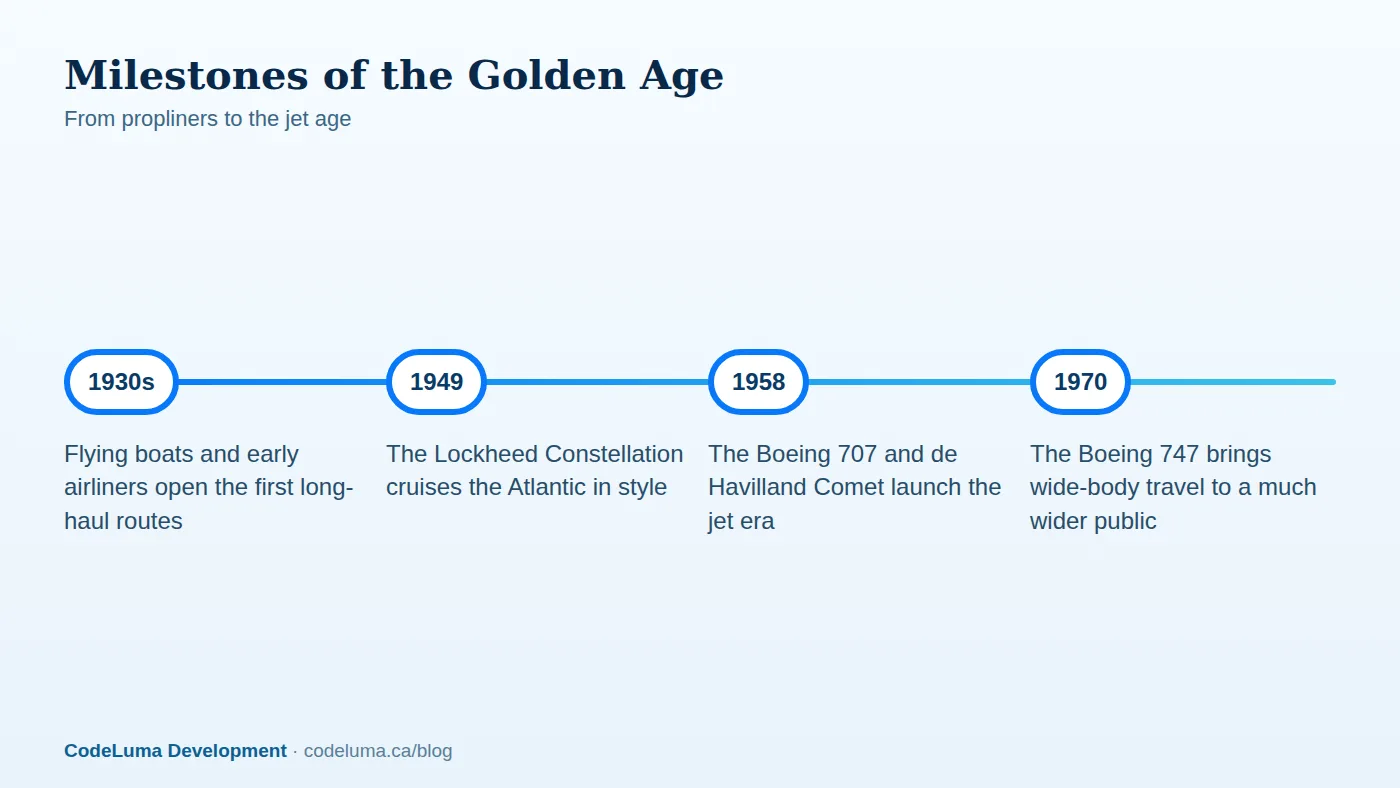
What "Golden Age" Really Meant
The term usually covers the decades when airlines like Pan Am, TWA, BOAC and Air France turned flying into a formal occasion. Propeller airliners such as the Lockheed Constellation and Douglas DC-7 crossed oceans on routes that took a full day or more with fuel stops. Cabins were smaller, engines were loud, and turbulence was rougher than most modern passengers would tolerate. What passengers got in return was space, attentive service, and the novelty of crossing continents faster than any ship.

The Glamour, and What It Left Out
It is easy to romanticize the era, but it is worth remembering who actually flew. Long-haul travel was a luxury far out of reach for most people, cabins were not pressurized as effectively as today's, and mechanical reliability was nowhere near current standards. The "golden" experience applied to a narrow slice of travellers. What has genuinely improved since then is not just comfort, but access: flying crossed over from an occasion for the few into an everyday tool for the many.
Legendary Routes of the Propeller and Early Jet Era
Some routes became famous in their own right. Transatlantic runs between New York and London or Paris carried the era's biggest names. Trans-Pacific "Clipper" flying boats hopped island to island across the ocean. The de Havilland Comet, the first commercial jetliner, briefly cut travel times dramatically before well-documented structural problems grounded it. The Boeing 707 that followed made transatlantic jet service reliable and helped define the routes still flown today.
Speed, Access and Comfort: What Actually Changed
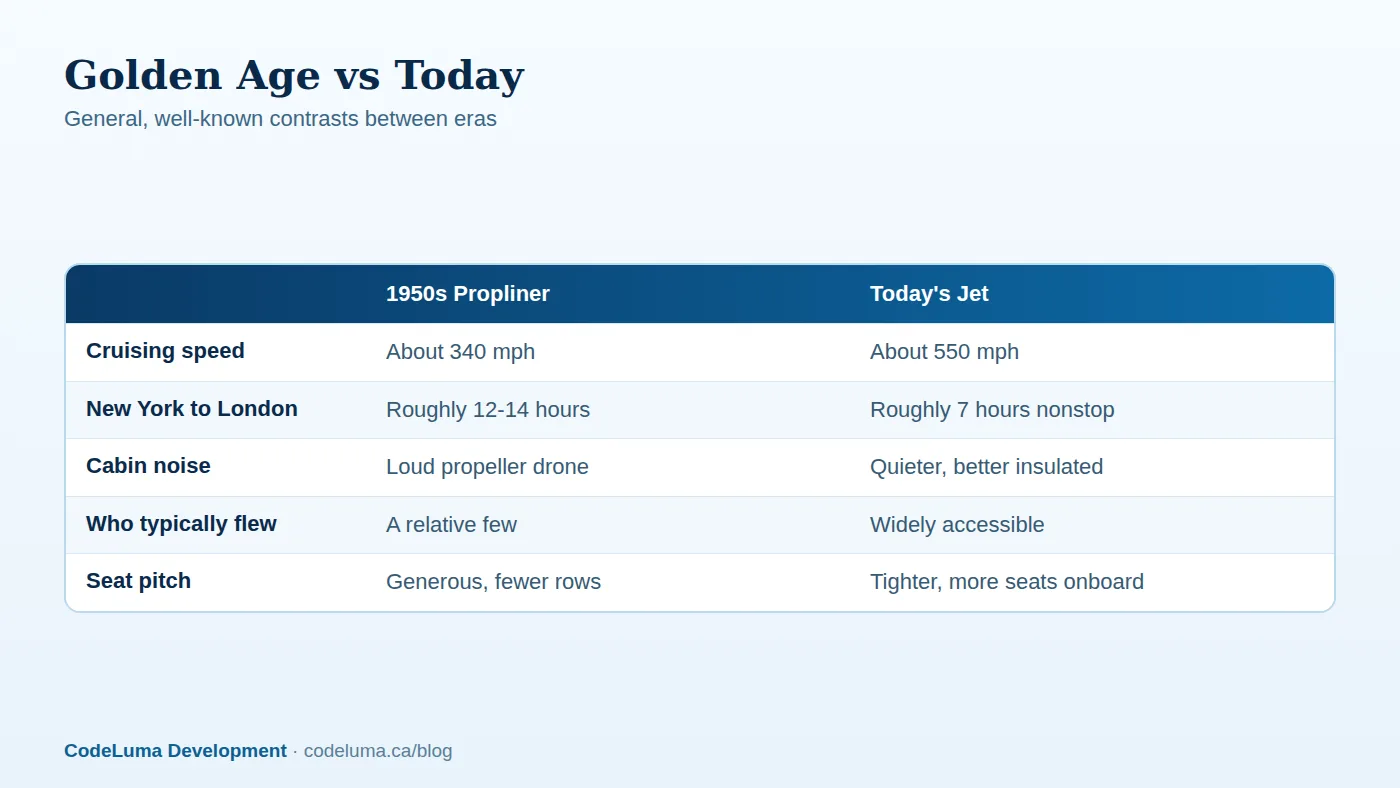
The biggest shift is not glamour, it is throughput. Modern jets cruise faster, fly longer distances nonstop, and carry far more passengers per flight than any propliner could. Cabin pressurization, noise insulation and weather radar have made flying smoother and more predictable. What has shrunk is personal space per passenger, as airlines fit more seats into the same fuselage. The trade-off between space and access is really the whole story of how air travel changed.
How to Use Map View to Chase Golden-Age Routes Today
Here is where the history gets fun to verify yourself. Many transatlantic and transcontinental routes from the propeller era, New York to London, Los Angeles to Honolulu, Chicago to Paris, are still flown daily, just by very different aircraft. Open SmartMarty Sky's Map View and follow these steps:
- Pick a classic route from an old timetable or history book, such as New York to London or Sydney to San Francisco.
- Search Map View by region or scroll to the two airports and watch for aircraft tracks along that corridor.
- Tap an aircraft's live track to see its callsign, and compare the flight time you see against historical accounts of the same route.
- Check the airport directory for the departure and arrival airports to see how their traffic has grown since the propeller era.
- Save the route or aircraft if you want to check back and watch it fly again another day.
A Quick Checklist for a Golden-Age Route Hunt
- A route name from aviation history, not just an airport pair
- Map View open on a phone, tablet or browser, no receiver required
- A rough sense of the original propeller-era flight time for comparison
- Patience, since long-haul routes may only have one or two daily departures
- Curiosity about which airline now flies the corridor, since it is rarely the original carrier
- A note of the aircraft type shown, to compare against the propliner it replaced
Common Mistakes When Comparing Eras
The most common mistake is assuming a modern route named after two cities is flown the same way it always was. Stopover patterns, non-stop capability, and even which airport in a city pair is used have all changed. Another mistake is comparing comfort in isolation without considering how few people could actually afford to fly then. Finally, spotters sometimes expect every historic route to still exist; some genuinely disappeared as aircraft range and demand patterns shifted, which is worth researching rather than assuming.

Why Some Classic Routes Disappeared
Not every Golden Age route survived. Fuel-stop routes made obsolete by longer-range jets, like island-hopping Pacific routes, largely vanished once aircraft could fly the distance nonstop. Other routes shifted airports as cities built newer hubs. And some simply lost enough demand once faster, more direct competitors appeared. Comparing old timetables with a modern airport search is a genuinely interesting way to see this evolution rather than just reading about it.
Aircraft Today That Echo the Era
While propliners are gone from mainline service, some routes are still flown by aircraft built for long, comfortable hauls in a way that echoes the era's ambition, from the Boeing 747's legacy of wide-body travel to today's twin-engine long-haul jets. Reading recent aviation news coverage of new long-haul routes is a good way to see which corridors are being revived or extended, sometimes on the very same city pairs that made headlines seventy years ago.
Why Live Tracking Matters for History-Minded Spotters
Tracking apps did not exist in the Golden Age; passengers and spotters relied on printed timetables and airport announcements. Today, live tracking lets curious travellers connect that history to the present moment, watching an aircraft cross an ocean corridor in real time rather than just reading about it. It will not tell you anything about flight safety or air traffic control, but as an information and enthusiast tool, it turns aviation history from something you read into something you can watch unfold.
The Wrap-Up
The Golden Age of air travel was glamorous for the few who could afford it, and genuinely rougher than modern flying in ways nostalgia tends to smooth over. What has not changed is the appeal of the great long-haul routes that defined the era. Many of them are still flown today, just faster, fuller, and by very different aircraft. Next time you see a transatlantic or trans-Pacific flight overhead, pull up Map View and see for yourself how the old route is still very much alive. For more on how spotting culture has evolved, see Plane Spotting for Beginners.
See what is flying overhead
Curious how many of those classic Golden Age routes are still crossing the sky right now? Open SmartMarty Sky's Map View and trace them yourself, no receiver or account needed to look. New users can also claim 100% free access to try Sky View's radar-style tracking in real time.
- Airport directory - medium and large airports worldwide, browsable by country.
- Aviation news - sourced aviation reports and searchable archives.
- Create your free account - SmartMarty Sky is 100% free, with no ads and no credit card.
- Install SmartMarty Sky - Android, iPhone and iPad web app, Windows, Linux and browser options.
Look up and know. SmartMarty Sky shows live nearby aircraft on a radar-style Sky View and a worldwide map. Every feature is 100% free — no ads and no credit card. It is an enthusiast information tool, not a navigation or safety system.