
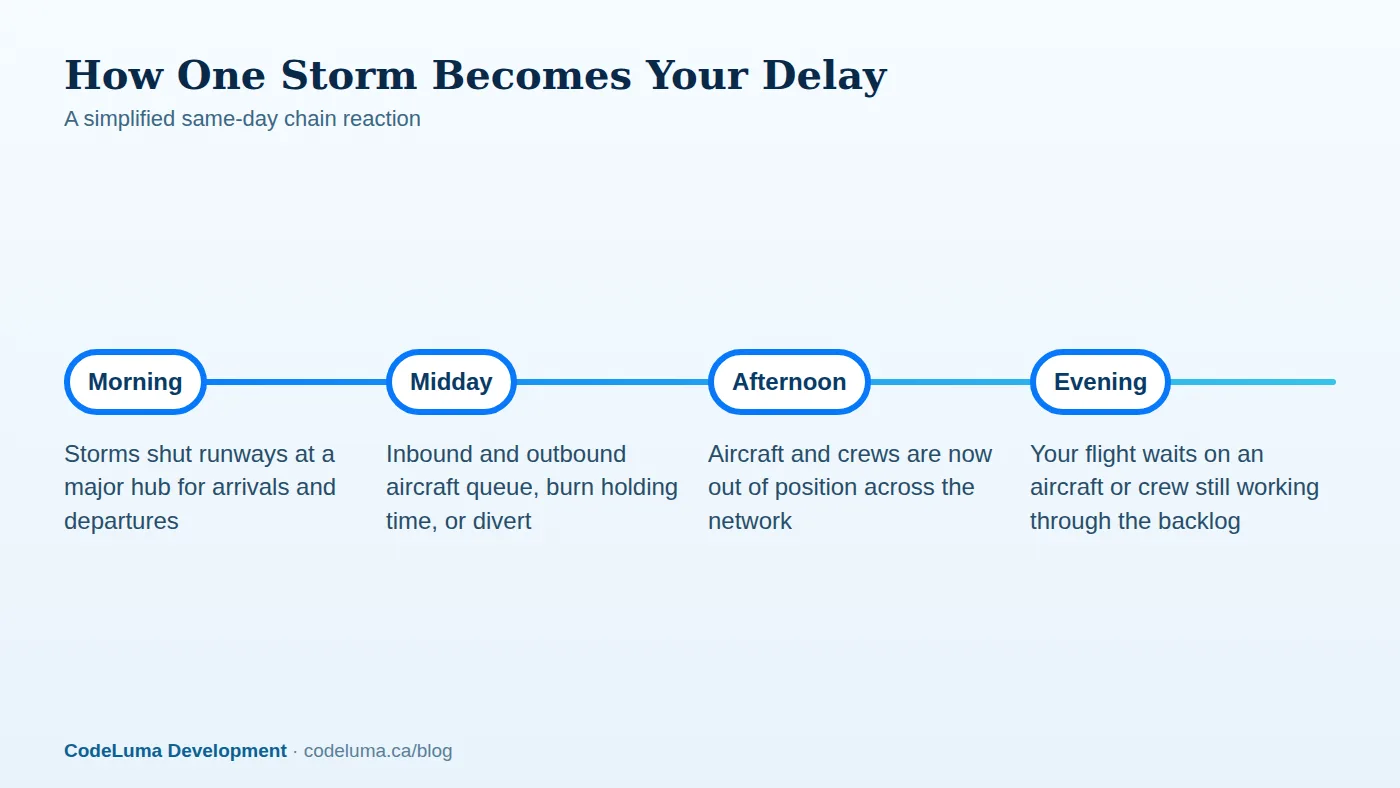
You check in, get to the gate on time, and watch the departure board flip to "Delayed" even though the sky outside is perfectly clear. The likely explanation has nothing to do with your airport at all. Modern airline schedules are built like a chain of dominoes: the same aircraft, and often the same crew, fly several legs in a single day. When weather disrupts one link in that chain, often hours earlier and hundreds of kilometres away, the delay travels down the line until it reaches you. Understanding this ripple effect turns a frustrating mystery into something you can actually see happening, especially if you know where to look on a live map.
The Hidden Schedule Behind Every Flight
Every aircraft flies multiple segments a day, often called "rotations." A single airplane might fly from Toronto to Chicago, then Chicago to Denver, then Denver back to Toronto, all before midnight, all with the same tail number. Airlines plan these rotations tightly to keep aircraft earning revenue instead of sitting idle. That efficiency is great for ticket availability, but it means very little slack is built in. If the first leg of the day runs late, every later leg on that same aircraft inherits some of that lateness, unless the airline can swap in a spare plane or crew.

Why Distant Weather Matters So Much
Thunderstorms, heavy snow, low visibility fog, and strong crosswinds can all force an airport to slow its arrival and departure rate, sometimes for hours. Air traffic control has to keep aircraft safely spaced, so when conditions worsen, controllers reduce the number of planes allowed to land or take off per hour. That single constrained airport can back up traffic across an entire regional or national network, because aircraft and crews that were supposed to be there on time are now stuck elsewhere, or circling in a holding pattern burning extra time and fuel.
The "Reactionary Delay" Effect
Aviation planners have a name for this: a reactionary delay, meaning a delay caused not by anything happening at your airport, but by a problem earlier in an aircraft's or crew's day. A storm in the morning at one hub can still be producing late departures at unrelated airports well into the evening. This is why a flight can push back late on a beautiful, calm evening. The airplane, or the pilots and flight attendants assigned to it, simply hasn't caught up yet.
Hub Airports Amplify the Problem
Not all airports have equal power to disrupt the network. Major hub airports handle enormous volumes of connecting traffic, funneling passengers, aircraft, and crews through a single point. When weather hits a hub, the effect multiplies, because dozens of aircraft due to continue on to dozens of other cities are all delayed at once. A regional airport with only a handful of daily departures simply cannot cause the same scale of disruption, even in identical weather.
Crew Duty Limits Add Another Layer
Flight crews operate under strict duty-time regulations designed around fatigue and rest requirements. If a delay pushes a crew close to its legal duty limit, the airline may need to find a replacement crew before the aircraft can depart, even if the plane itself is ready and fueled. This is a completely separate reason a flight can sit at the gate long after the weather that caused the original delay has cleared. The airplane is fine; the people flying it have simply run out of legal hours.
How to See the Pattern on a Live Map
This is where live tracking becomes genuinely useful for travellers, not just for hobbyists. Instead of wondering, you can watch it happen. Open SmartMarty Sky and use Map View to look up the incoming aircraft assigned to your flight, often listed on the airline app or airport board by registration or flight number. You can see where that aircraft currently is, whether it has even departed its previous airport yet, and whether its route shows signs of holding patterns or a reroute around weather.
A Simple Step-by-Step Check
- Find your flight's aircraft registration or callsign, often shown on your airline's app under flight status.
- Search that identity in SmartMarty Sky using Map View, which has no distance limit, unlike Sky View's fixed 200 kilometre radius.
- Check whether the aircraft has departed its previous city yet, and how late that departure looks.
- Look at the route shape for signs of prolonged holding or a long diversion.
- Check the weather at that distant origin airport separately, since bad weather there explains delayed departures better than anything happening at your own gate.

Reading the Wider Network
One delayed aircraft tells you about one flight. But if you check recent route and fleet activity or browse aircraft near a major hub in Map View, you may notice a whole cluster of aircraft sitting on the ground longer than usual, or several flights queued in holding patterns near one city. That pattern is a strong sign of a regional weather event rippling outward, rather than an isolated mechanical or staffing issue.

Common Mistakes Travellers Make
- Assuming clear local skies mean no weather delay. The storm causing your wait may be a thousand kilometres away and long since cleared by the time you notice the delay.
- Blaming the airline unfairly. Airlines don't control the weather or air traffic flow restrictions; they can only manage aircraft and crew assignments around them.
- Ignoring the incoming aircraft's status. If the plane assigned to your flight hasn't even taken off from its previous stop, no amount of waiting at your gate will change the outcome.
- Expecting live tracking to predict outcomes. It shows you what is happening right now, which is genuinely useful context, but it is not a forecasting or safety tool.
Why This Matters Beyond Curiosity
Understanding reactionary delays doesn't just satisfy curiosity, it changes how you plan. If you can see that your inbound aircraft is still an hour from departing its origin city, you know a tight connection is at genuine risk, and you can make calmer decisions about rebooking, meals, or contacting the airline early instead of waiting anxiously at the gate for an announcement. For plane spotters and aviation fans, the same information turns a routine delay into an interesting real-time story about how the whole air travel network is interconnected. You can browse airport pages for major hubs to see typical traffic patterns, or check aviation news for reports on significant weather events affecting travel.
Wrapping Up
The next time a delay notice appears with no obvious local cause, remember that your aircraft has likely had a busy day already, starting somewhere else entirely. Weather at a distant airport, tight crew duty limits, and the domino effect of aircraft rotations all combine to produce delays that seem to come out of nowhere. With a live map in hand, "nowhere" becomes a specific, visible place, and that clarity alone makes waiting a little easier. If you're new to live tracking, it's worth having in your pocket well beyond delay-watching, from plane spotting to simple curiosity about the aircraft passing overhead.
See what is flying overhead
Curious whether your delay is really about the weather at your gate or a storm three time zones away? Open SmartMarty Sky's Map View and follow the incoming aircraft's own history to see for yourself. New accounts get a one-time 60-minute live-access trial, no receiver or API key required.
- Start the free trial - a one-time 60-minute live-access trial for new accounts.
- Airport directory - medium and large airports worldwide, browsable by country.
- Aviation news - sourced aviation reports and searchable archives.
- Install SmartMarty Sky - Android, iPhone and iPad web app, Windows, Linux and browser options.
Look up and know. SmartMarty Sky shows live nearby aircraft on a radar-style Sky View and a worldwide map. New accounts can use a one-time 60-minute live-access trial. It is an enthusiast information tool, not a navigation or safety system.