
Watching aircraft climb out or line up on final approach is one of the simplest hobbies to start and one of the hardest to put down. You do not need a permit, a membership, or specialized equipment to begin. You need a public place to stand, a rough idea of what is scheduled to arrive, and a way to identify what you are looking at once it appears. This guide walks through a first outing from planning to your first logged sighting, and shows how live tracking fits into every step.
Why Your First Outing Deserves a Little Planning
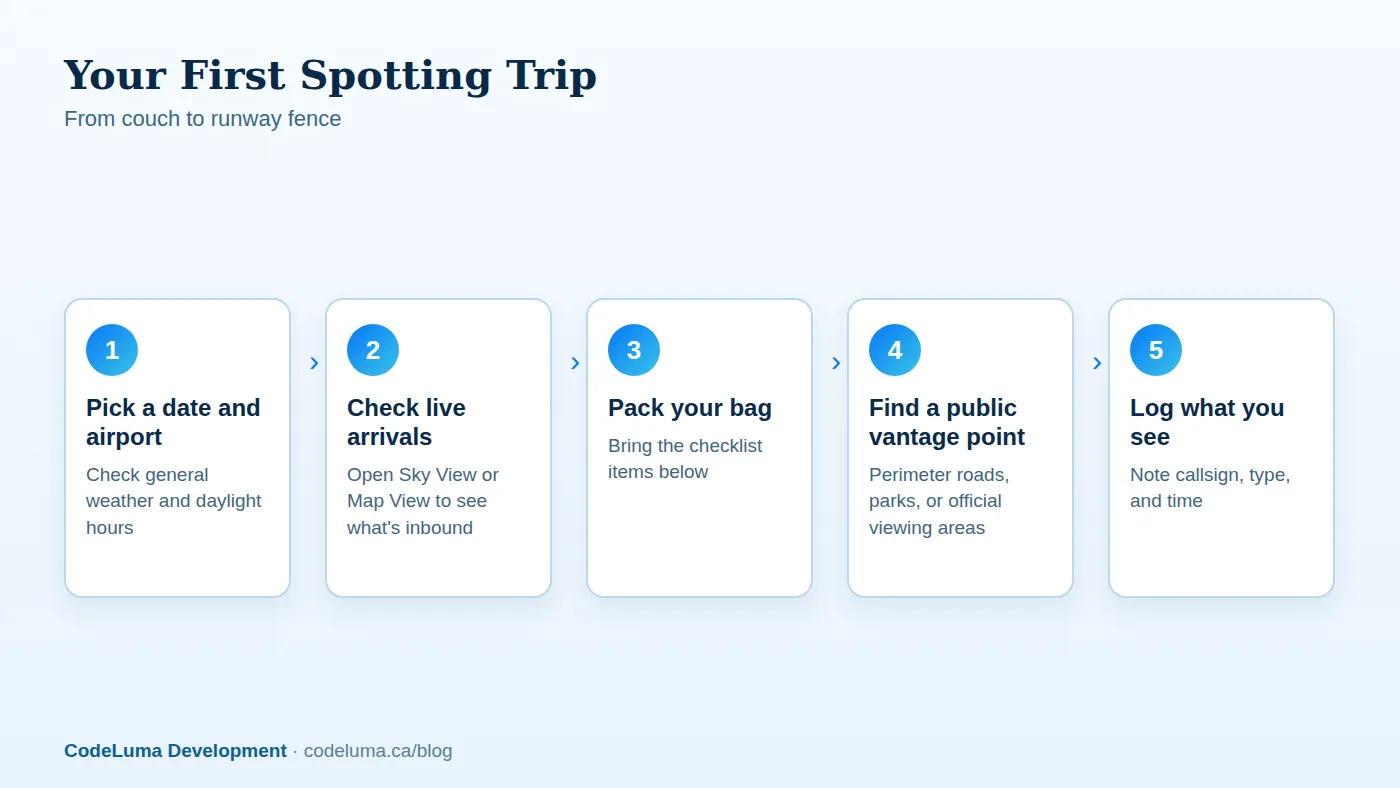
Plane spotting rewards a bit of preparation. Arriving at a random time with no idea of the airport's layout often means a lot of standing around with nothing overhead. A short amount of homework, checking which runway is likely in use, what the weather looks like, and what public areas exist, turns a hit-or-miss visit into a productive one. It also helps set realistic expectations: some days bring a steady stream of arrivals, others are quieter, and that variability is part of the hobby.

What to Pack for a Day of Spotting
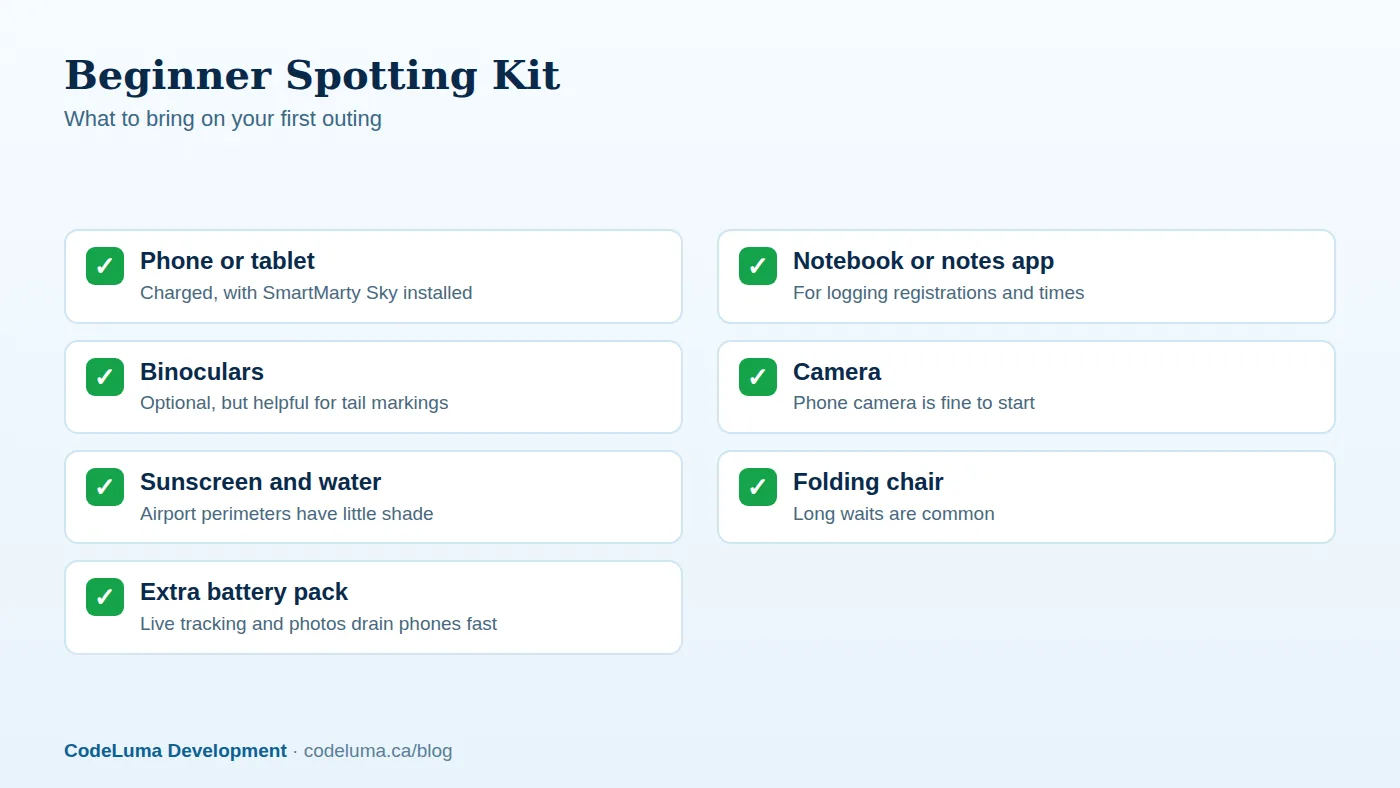
You do not need expensive gear to get started. A phone, a notebook, and comfortable shoes will carry most beginners through their first several outings. As you get more into it, binoculars and a dedicated camera become worthwhile upgrades, but they are not required on day one.
- A charged phone or tablet
- A notebook or notes app for logging sightings
- Water, sunscreen, and a hat
- A folding chair if you plan to stay a while
- A portable battery pack
Choosing a Public Vantage Point
Every airport has different rules and different informal spotting locations, so it helps to research yours before you go. Look for perimeter roads, public parks near the approach path, or designated viewing areas that some larger airports maintain. Stick to public property, respect any posted signage, and never enter restricted or fenced sections to get a closer look. For a deeper walkthrough on evaluating angles, lighting, and noise, see our guide to picking the best spotting spot.
Check the Skies Before You Leave Home
One of the most useful habits a beginner can build is checking live arrivals before heading out. Rather than guessing whether anything interesting is inbound, you can look at a live picture of the surrounding airspace from your couch. This is where starting a free account of SmartMarty Sky pays off immediately: you can browse Map View for your home airport and get a sense of typical traffic patterns before committing your afternoon.
Reading Sky View Like Air Traffic Radar
Once you are near the airport, SmartMarty Sky's Sky View becomes especially handy. It gives you a radar-style live view of aircraft within a fixed 200 kilometres, oriented the way a traditional radar screen would be, so you can see what is approaching from which direction before it comes into visual or audible range. This is a huge help for beginners who are still learning to judge distance and direction by ear and eye alone. If you want to understand what is actually powering that live picture, our explainer on ADS-B breaks down the public broadcast signals aircraft send out.
Turning Blips Into Identified Aircraft
Seeing a dot on a screen is only half the fun; naming what it is turns spotting into a hobby with real depth. SmartMarty Sky lets you search worldwide by callsign, registration, or ICAO identity, so once you spot an aircraft on Sky View or in the sky, you can tap through to see its details. Keep in mind that coverage, aircraft details, and routes depend on available public broadcasts and verified records, so some information may be incomplete or missing depending on the aircraft and the moment.
Logging Your First Sightings
Most spotters keep some kind of log, even if it is just a simple notebook. Recording the date, time, aircraft type, registration, and airline gives you a personal record to look back on and helps you notice patterns, like which routes fly at which times of day. Many spotters also use the saved aircraft feature in SmartMarty Sky to keep a running list of notable sightings without needing a separate notebook at all.

Photography and Video Basics
You do not need a telephoto lens to start photographing aircraft. A phone camera captures perfectly good documentation shots, especially of aircraft on approach or taxiing near a public perimeter road. SmartMarty Sky also includes user-controlled photo and silent video captures within the app, which some spotters use alongside their regular camera to build a combined record of a sighting with its live tracking data. As your interest grows, a basic zoom lens or a secondary camera body is a natural next investment.
Common First-Timer Mistakes
A few missteps trip up almost every beginner at least once. Knowing them ahead of time saves a wasted trip.
- Showing up without checking which runway is active, and standing on the wrong side of the airport
- Forgetting sun protection and water during long waits
- Trying to identify every aircraft from memory instead of using a live tracking tool
- Getting too close to fences or restricted areas for a better photo
- Not writing anything down, then forgetting details within a day or two
Airport Etiquette and Staying Safe
Good spotting habits protect the hobby for everyone. Stay on public land, follow posted rules, and never trespass onto airport property to get closer to the action. Avoid blocking driveways, gates, or emergency access when parking near a spotting location, and be mindful of noise and privacy for anyone living nearby. It is also worth remembering that SmartMarty Sky is an information and enthusiast tool, not an aviation safety or navigation tool, and it should never be used as a substitute for official air traffic guidance in any context.
Wrap-Up: Your Next Outing
Your first day of plane spotting does not need to be complicated. Pick a public spot, check what is expected to arrive, bring the basics, and log what you see. Live tracking takes the guesswork out of the waiting, turning a quiet afternoon into a session where you know roughly what is coming and can focus on enjoying the sight of it arriving. Once you have your first few sightings logged, browsing the airport directory for other nearby fields is a natural way to plan your second trip.
For more background on the hobby and the technology behind it, the general overview of aircraft spotting on Wikipedia is a solid starting point alongside our own guides.
See what is flying overhead
Before your first outing, open SmartMarty Sky and see what is inbound to your local airport in real time. New accounts get 100% free access, so you can test Sky View and Map View before you even leave the house.
- Create your free account - SmartMarty Sky is 100% free, with no ads and no credit card.
- Install SmartMarty Sky - Android, iPhone and iPad web app, Windows, Linux and browser options.
- Airport directory - medium and large airports worldwide, browsable by country.
- Blog - more aviation stories and guides.
Look up and know. SmartMarty Sky shows live nearby aircraft on a radar-style Sky View and a worldwide map. Every feature is 100% free — no ads and no credit card. It is an enthusiast information tool, not a navigation or safety system.