
Anyone can stand near an airport and see planes. A great spot is different: the aircraft are close, the light is good, you are comfortable, and you are in a place where you are actually allowed to be. The good news is that the criteria are the same everywhere, so once you know them you can scout a new airport in minutes instead of guessing.
Start with the runway layout
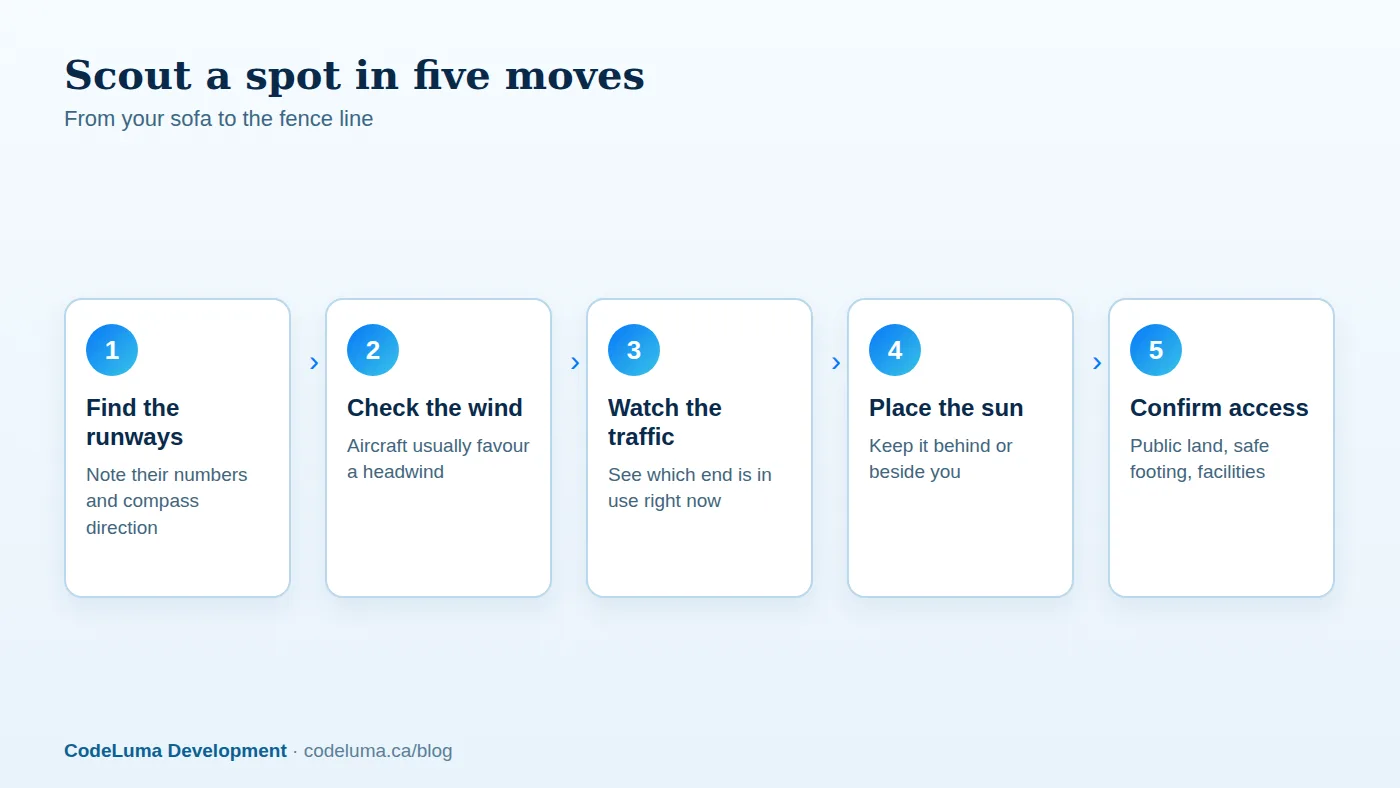
Every viewing decision starts with the runways. A runway number is its magnetic heading divided by ten and rounded, so runway 27 points roughly west (270 degrees) and the opposite end of the same strip is runway 09. Where an airport has parallel runways, the letters L, C and R separate left, centre and right.
Look at a satellite view before you go. Note how many runways there are, how they cross, and where the roads and public land sit relative to them. A spot near a runway intersection or beside the terminal apron often gives you more variety than a spot at the far end of a single strip.

Read the wind to predict the active runway
Aircraft generally take off and land into the wind, because it shortens the distance they need and gives a steadier approach. That means the wind direction usually decides which end of a runway is in use. A westerly wind tends to favour runway 27, an easterly wind runway 09. Some airports also prefer certain runways at night to reduce noise, and the setup can change during the day when the wind shifts.
So a spot that is perfect this morning can be quiet after lunch. If you can, choose a location that works for both directions of your main runway, or pick a place near the middle of the airfield.
Approach end or departure end?
Where you stand along the runway changes what you see. At the approach end, aircraft are low and relatively slow on final, which gives a long, head-on view. At the departure end, you see takeoff power, rotation and climb, but you also hear much more noise.

The side of the runway matters too. Standing beside the runway near the middle gives a side-on view of the landing roll and taxi movements, which many spotters find the most satisfying for identifying aircraft types and airline liveries.
Put the sun on your side
For photography or simple clear viewing, you generally want the sun behind you or off to one side. Looking toward the sun turns aircraft into dark silhouettes and adds glare. The sun rises roughly in the east and sets roughly in the west, so a spot on the north or south side of an east-west runway will often be lit for a large part of the day, depending on your hemisphere and the season.
Low-angle light around sunrise and sunset is flattering, and evening light can make a dusk arrival look spectacular. Also remember that heat rising off hot tarmac can blur distant subjects on summer afternoons, so a closer spot often beats a distant one.
Check access before anything else
A view is worthless if you cannot use it legitimately. Spot from public places: public roads with safe pull-offs, parks, designated viewing areas, hills and shorelines. Never climb fences, enter restricted areas or stop where you obstruct access roads. If staff or security ask you to move, be polite and do so. Airport and local rules differ, and drone rules in particular vary widely, so check what applies before you bring anything beyond a camera or binoculars.
Count the facilities
Comfort decides how long you stay. When you compare spots, weigh these:
- Parking that does not block anyone, and a safe walk from your car
- Toilets, food and drinks within reasonable reach
- Shelter from rain, wind or strong sun
- Level, firm ground for a chair or tripod
- A clear view without trees, fences or lamp posts in the frame
- Phone signal, so live tools keep working
Also think about ear protection near the departure end, and dress for the weather. Airfields are often exposed and windier than the surrounding town.
Scout from home with SmartMarty Sky
This is where live tracking pays off. Open Map View, which is a zoomable world map with no distance limit, and watch the traffic around your chosen airport. You will see which direction aircraft are arriving from and which way they turn after takeoff, which shows you the active runway without any guesswork. You can also check the local weather in the app to see how the wind might shape things later.
Start from the airport directory to find the airport, then compare what you see with your satellite view. The technology behind those positions is public ADS-B broadcasting, explained in ADS-B explained simply. Coverage and details depend on what is being received and verified, so treat it as a planning aid, not a guarantee. SmartMarty Sky is an enthusiast and information tool. It is not for navigation, air traffic or safety use.
Use Sky View once you arrive
On site, Sky View gives you a radar-style picture of aircraft within a fixed 200 kilometres, so you can see what is about to arrive before it appears over the trees. Use saved aircraft and alerts if there is a particular aircraft you hope to catch. You can search by callsign, registration or ICAO identity, then look up to match the real thing to the screen. That turns a quiet hour into a satisfying one. If you want it on your phone, see the install options for Android, iPhone and iPad, Windows, Linux and browsers.
Common mistakes
- Ignoring the wind. Picking a spot for the wrong runway end and watching empty tarmac.
- Shooting into the sun. Great position, terrible silhouettes.
- Trespassing for a better angle. It risks your access and everyone else's.
- Standing too far away. Distance and haze flatten the view.
- Not planning for a change. Wind shifts can move traffic to another runway.
- Skipping the basics. No water, no shelter, no charged phone.
A quick wrap-up
Good spotting spots come from five things: runway alignment, wind, sun, access and facilities. Check them in that order, use SmartMarty Sky to see how traffic really flows, and always keep to public places and airport rules. Do that and you can walk up to almost any airport and find a good place to watch within minutes.
See what is flying overhead
Before your next airport visit, try SmartMarty Sky to see which way traffic is flowing and what is arriving, so you can choose your spot with a plan. New accounts can start the one-time 60-minute live-access trial and scout a runway from your phone before you leave home.
- Airport directory - medium and large airports worldwide, browsable by country.
- Start the free trial - a one-time 60-minute live-access trial for new accounts.
- Install SmartMarty Sky - Android, iPhone and iPad web app, Windows, Linux and browser options.
- Blog - more aviation stories and guides.
Look up and know. SmartMarty Sky shows live nearby aircraft on a radar-style Sky View and a worldwide map. New accounts can use a one-time 60-minute live-access trial. It is an enthusiast information tool, not a navigation or safety system.