
Fall air show season in the northern United States is winding down, and the month's one unmissable date lands in Wichita, Kansas. McConnell Air Force Base brings back its Frontiers in Flight Open House and Air Show on October 24 and 25, 2026, headlined by the U.S. Air Force Thunderbirds. It is the kind of weekend plane spotters plan around, with a packed flying program, a deep static display, and a base that does not open its gates for this every year. It is also a good excuse to see how much of the action you can follow before you even leave the house, from the warm-up flights in the days before to the last performer taxiing back in once the crowds head home.
Kansas hosts the fall season's marquee show
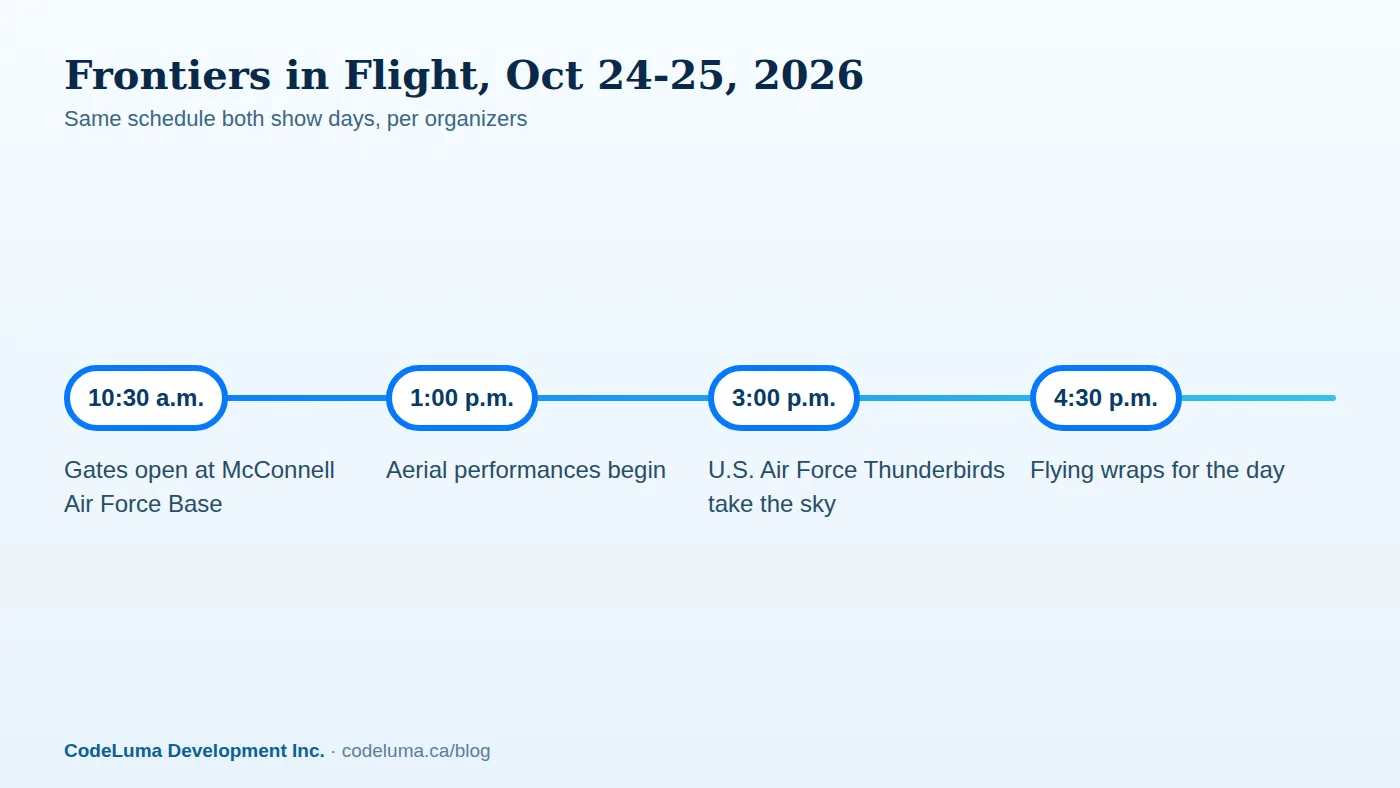
According to KAKE News, gates at McConnell AFB open at 10:30 a.m. both days, with aerial performances running from 1 to 4:30 p.m. and the Thunderbirds taking off around 3 p.m. in their F-16 Fighting Falcons. Admission to the base is free. KAKE reports it is the first time McConnell has hosted parachutists at the show since 2022, and the first Thunderbirds appearance over Wichita since September of that year.
The lineup: Thunderbirds lead a deep card
Ahead of the Thunderbirds, KAKE's rundown lists the U.S. Air Force Academy's Wings of Blue parachute demonstration team, aerobatic pilot Scott Francis, a dual flyover from McConnell's own KC-135 Stratotanker and KC-46A Pegasus, vintage-aircraft flyer Matt Younkin, SubSonex Mini Jet pilot Tom Larkin, and Pitts S-2S performer Brian Correll. That is a lot of distinct aircraft types in one afternoon, and most of them are only in the sky for a few minutes apiece, which is exactly the kind of fast-moving lineup that rewards having a live tracker open.
The static ramp: tankers, a B-29, and Cold War icons
Visit Wichita's event write-up lists the static display as including the B-29 Superfortress "Doc," a Beechcraft T-6 Texan II, a Northrop T-38 Talon, a Bombardier Global 8000, the KC-46A Pegasus and KC-135 Stratotanker, an F-35 Lightning II, a C-17 Globemaster III and an A-10 Thunderbolt II. Several of those, including the tankers based at McConnell, fly in and out under their own power in the days around the show rather than simply sitting on display.
Watching the ferry flights come and go
Part of the fun of a big open house is that the show itself is only the visible fraction of the traffic. Visiting performers, tanker aircraft repositioning, and support flights all tend to move in and out of the area in the days before and after, often well outside the advertised show hours. Civilian aerobatic performers in particular tend to arrive and depart on their own schedules rather than as a group, so a quiet weekday afternoon can turn up just as much activity as show day itself. You won't always know a ferry flight's exact timing in advance, but checking the airport directory for nearby fields gives you a sense of what normally flies there, and watching for unfamiliar callsigns in the area is half the fun of a show weekend.
Saving the aircraft you want to follow
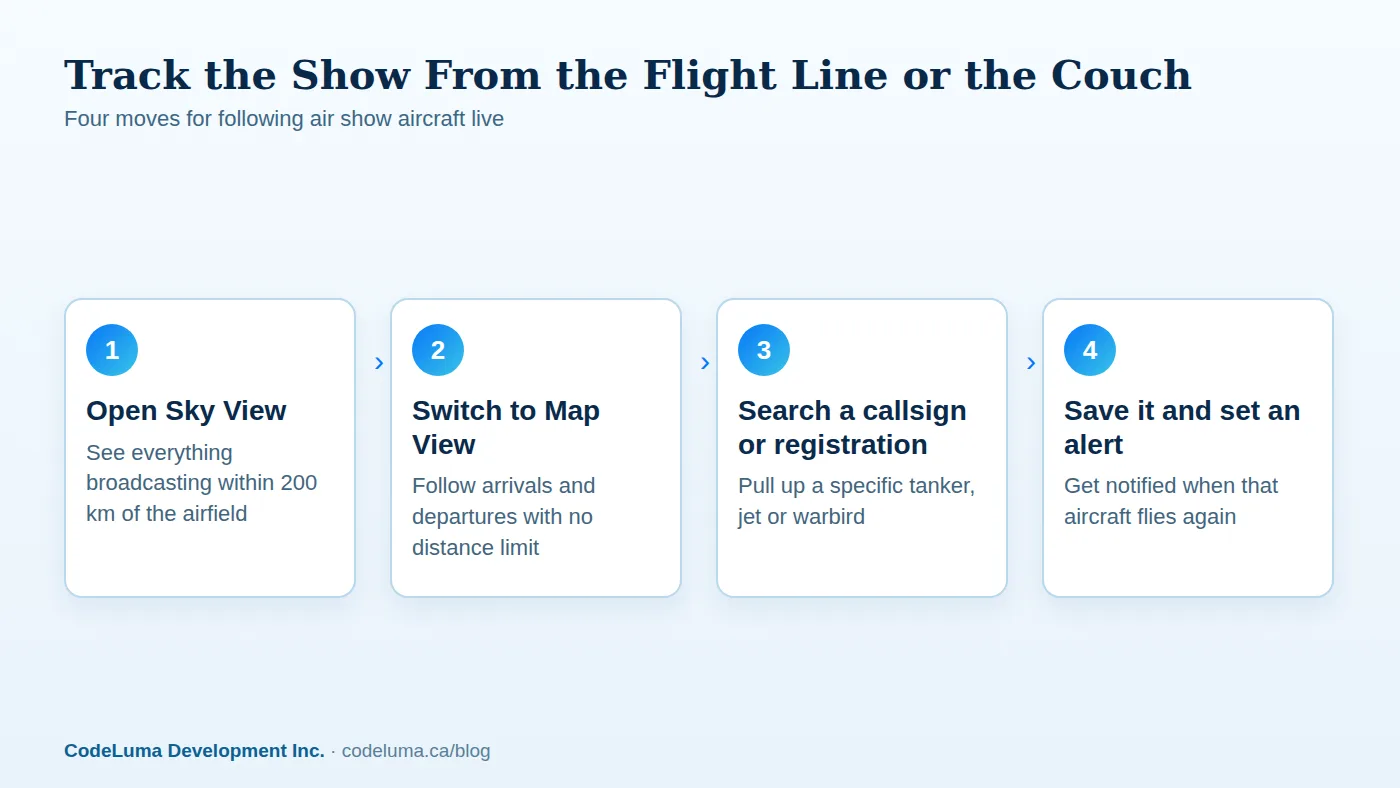
This is where a live tracker earns its place on your home screen. Search by callsign, registration or ICAO identity to pull up a specific aircraft, then save it so you can check back without searching again. If that aircraft becomes active, an alert lets you know, which beats refreshing a map every few minutes while you're trying to enjoy the show. New accounts get a one-time 60-minute live-access trial, which is enough to try this out for a single flying window without committing to anything.
A weekend game plan for October 24-25
Both show days follow the same schedule: gates open at 10:30 a.m., flying runs 1 to 4:30 p.m., and the Thunderbirds close the show around 3 p.m. If you'd rather watch from outside the fence, the Kansas Aviation Museum, next door to the base, is running its own watch party both days with open seating on its tarmac and field, food trucks and family entertainment, according to the Kansas Aviation Museum's own event page. The museum notes its airshow-day gates open at 11 a.m., and that the base itself is not accessible from the museum side.
Spotting responsibly from outside the fence
Whether you're on base or watching from a public road or park nearby, stick to public property and posted areas, follow any instructions from base security or event staff, and never approach a fence line or restricted area to get a better photo. The watch party model used by the Kansas Aviation Museum is a good template for shows elsewhere: public land, a clear line of sight, and no need to be anywhere near the operational side of the airfield. A live map view is a legal, respectful way to know what's overhead without needing to get closer than you should.
Checklist before you go, or tune in
- Confirm the current schedule and gate times on the show's own channels before you travel
- Bring a government-issued photo ID if you're 18 or older, per base entry rules
- Pack hearing protection for kids, since jet demonstrations are loud at close range
- Save the performer and support aircraft you want to follow before the gates open
- Switch between Sky View for close-in action and Map View if you want to follow something farther out
- Set an alert on anything you want to catch departing after the show wraps
Common mistakes to avoid
The most common misstep is treating a saved search as a guarantee. Coverage depends on what aircraft are actually broadcasting public ADS-B data at the time, so a performer doing low-level aerobatics, or one that hasn't taken off yet, may simply not show up until it climbs and transmits. Another frequent mistake is assuming every aircraft at a show is trackable by name alone; searching by registration or ICAO identity, when you know it, is usually more reliable than a callsign that changes between flights. And remember that this kind of tool is for following the show out of curiosity, not for anything resembling navigation or safety use.
The wrap-up: one show, a full fall send-off
With a single marquee date left on the northern US fall calendar, Wichita's Frontiers in Flight is worth the planning, whether you're driving in for the weekend or just want to watch the comings and goings from afar. For more on how the underlying tracking technology works, see how live aircraft tracking works, and for other shows worth watching this season, check out fall air shows, fly-ins and open houses in Canada and the northern US.
Sources
- KAKE News: Thunderbirds to headline air show at McConnell AFB this fall
- Visit Wichita: McConnell Air Force Base Air Show and Open House
- Wichita on the Cheap: Wichita Air Show at McConnell AFB
- Kansas Aviation Museum: Airshow Watch Party
See what is flying overhead
Whether you're watching from the flight line in Wichita or following along from your couch, SmartMarty Sky lets you pull up any show aircraft by callsign or registration and watch it move. New accounts get a one-time 60-minute live-access trial, no receiver required.
- Start the free trial - a one-time 60-minute live-access trial for new accounts.
- Airport directory - medium and large airports worldwide, browsable by country.
- Install SmartMarty Sky - Android, iPhone and iPad web app, Windows, Linux and browser options.
- Aviation news - sourced aviation reports and searchable archives.
Look up and know. SmartMarty Sky shows live nearby aircraft on a radar-style Sky View and a worldwide map. New accounts can use a one-time 60-minute live-access trial. It is an enthusiast information tool, not a navigation or safety system.