
Canada's marquee air show season runs on a fairly predictable calendar, and by late September it has mostly wound down for the year. That doesn't mean the sky goes quiet, though. A couple of smaller, genuinely open events are still on the books this fall, and they're a good excuse to get your live-tracking setup dialed in before the next big show season rolls around.
What's on the radar this fall
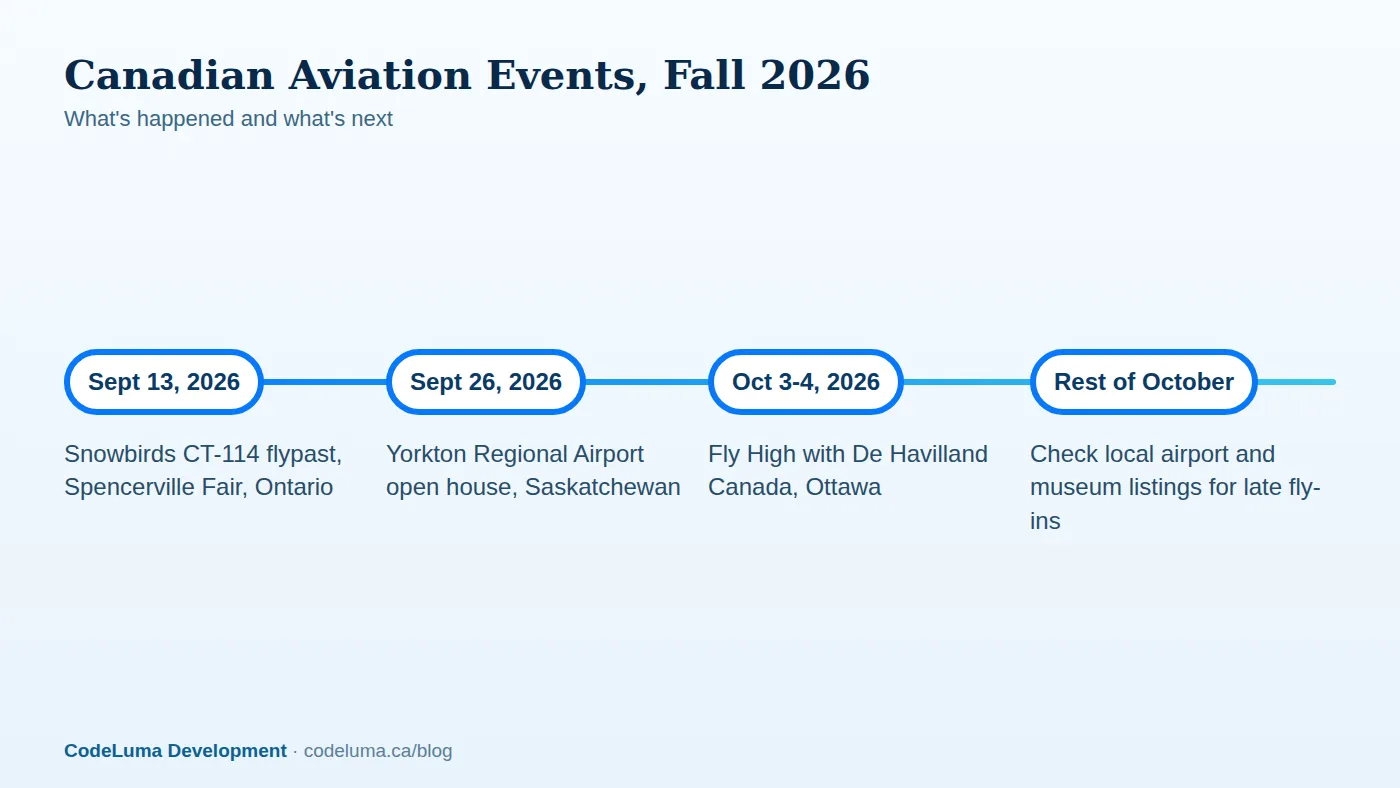
Two real events anchor this stretch of the calendar. Leading Edge Aviation hosted a fly-in open house at Yorkton Regional Airport in Saskatchewan on September 26, 2026, and the Canada Aviation and Space Museum in Ottawa runs a public event called "Fly High with De Havilland Canada" on October 3 and 4, 2026. Neither is a full military air show with a scripted flying program, but both put real aircraft, and real people who fly them, in front of the public.

Yorkton Regional Airport throws open its doors
According to MBC Radio, the September 26 open house at Yorkton Regional Airport included aircraft displays, discovery flights with instructors, and a barbecue running from 10:30 a.m. to 2:30 p.m. with proceeds going to STARS Air Ambulance. The event was built around introducing young people to flight training and multi-engine aircraft, a low-key but meaningful way to bring the community onto the airfield.
If you're in the area for a similar small-airport event, the airport directory is a fast way to check whether a field has a public page worth bookmarking before you go.
Ottawa's museum puts the Twin Otter on show
Over in Ottawa, the Canada Aviation and Space Museum is hosting "Fly High with De Havilland Canada" on October 3 and 4, 2026, at its site on Aviation Parkway next to the historic Rockcliffe Airport. The event invites visitors to see De Havilland Canada aircraft up close, meet pilots and aviation experts, and get a chance to take a flight aboard a Twin Otter, with aircraft on display outdoors for the weekend.
Because the museum sits right beside an active airfield, it's a reasonable spot to have Sky View open on your phone while you walk the static displays, watching for arriving and departing traffic in the background.
Why the big-ticket shows have already wrapped for 2026
The Canadian International Air Show closed out Toronto's Labour Day weekend in early September, and the Snowbirds finished their Canadian tour with a stop in Gatineau, Quebec from September 18 to 20, according to the Royal Canadian Air Force's own 2026 schedule page. From there the team's remaining appearances moved to California for early October. Locally, coverage of the Snowbirds' September 13 flypast over the Spencerville Fair in Ontario noted that "the 2026 season would be their last before a planned transition to a new aircraft platform" flying the CT-114 Tutor, a detail that made this year's Canadian stops a bit more notable for anyone tracking the team. With the headline acts done for the season, events like Yorkton and Ottawa are the more accessible options left on the calendar.
Getting Sky View ready before you head out
Sky View shows a radar-style live picture of aircraft within a fixed 200 kilometres of your location, which is plenty of range to catch traffic heading into a regional airport or a museum airfield well before it's overhead. A few simple steps make show day smoother:
- Open the app at your destination, or close to it, so the 200-kilometre view is centred where you'll actually be standing.
- If you know the registration or callsign of a visiting aircraft from an event program, search for it directly by callsign, registration or ICAO identity.
- Switch to Map View if you want to follow an inbound aircraft's full route before it reaches the fixed radar range of Sky View.
- Check the local weather panel in the app before you leave, since outdoor flying activity is often the first thing organizers scale back in poor conditions.
New accounts get 100% free access, which is enough time to get comfortable with both views on the morning of an event. You can also install SmartMarty Sky ahead of time on a phone, tablet or laptop so there's nothing to set up once you're standing at the fence line.
Setting up alerts so you don't miss the arrival
Saved aircraft and alerts are useful if you already have a specific registration in mind, for example a warbird or a visiting demonstration aircraft named in an event's own promotional material. Save it ahead of time, and you'll have a quicker way to spot it once it's broadcasting nearby, rather than scanning the whole 200-kilometre picture by eye. For open, come-one-come-off events like the Ottawa museum weekend, alerts are less about a single "must-see" aircraft and more about knowing when general traffic starts picking up around the field.
What live tracking can, and can't, tell you
It's worth being upfront about the limits here. SmartMarty Sky reads public ADS-B broadcasts, so coverage, aircraft details and routes depend entirely on what's actually being transmitted and on the accuracy of public records behind the scenes. Some smaller aircraft at a community fly-in, including gliders, vintage types and some general aviation traffic, may broadcast little or nothing, so you won't see everything on the ramp reflected on screen. The app is built for enthusiasts and curious spotters, not as an aviation safety or navigation tool, and it shouldn't be treated as one.

Your air show day checklist
A short pre-trip list keeps a fall outing from turning into a wasted drive.
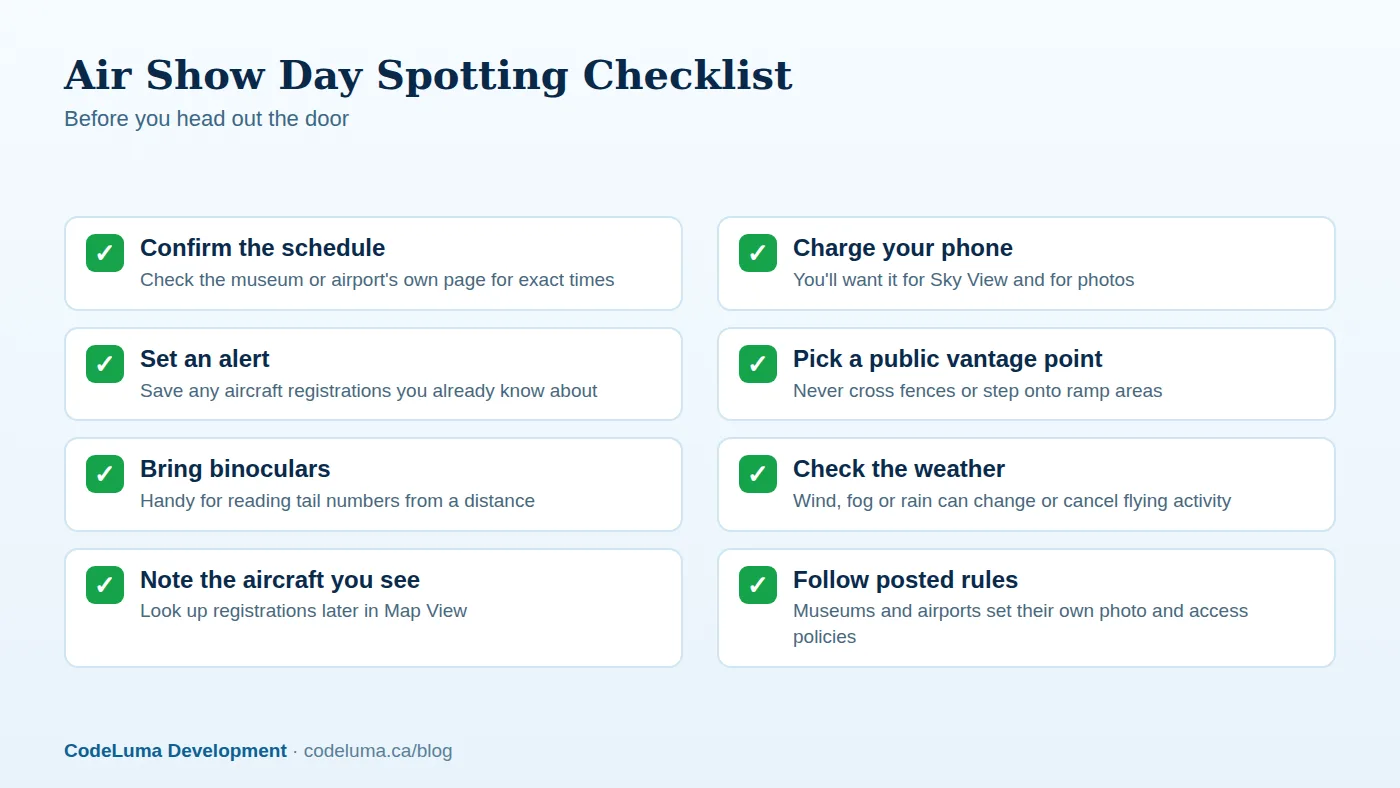
If you're new to the hobby entirely, our beginner's guide covers the basics of a first spotting trip in more depth.
Common mistakes plane spotters make
A few habits trip up even experienced spotters on event days. Showing up right at the advertised start time, rather than earlier, often means missing the first arrivals. Assuming an outdoor static display will run rain or shine is another: weather scrubs or shortens plenty of small events without much notice. And relying purely on a printed schedule instead of also watching live traffic means missing changes in real time, whether that's an early arrival or a delayed one.
Spot responsibly: rules, fences and privacy
Museum grounds and small airports set their own rules about where visitors can stand and what can be photographed, and those rules exist for good reason around active aircraft movement. Stick to public areas, follow posted signage, and never cross a fence line or step onto a ramp to get a closer shot. It's also worth remembering that tracking public flight data is not the same as investigating who owns or operates a specific private aircraft; keep your curiosity pointed at the aircraft and the event, not at speculating about the people flying them.
Wrap-up: keep watching after the show ends
Between the Yorkton open house and Ottawa's De Havilland weekend, there's still real aviation activity worth catching in Canada this fall, even with the big-name air shows behind us for 2026. For a broader look at what's on later in the season across the country and into the northern United States, our fall fly-ins roundup is a good next stop. Whatever event you plan around, a little setup time with Sky View and the airport directory beforehand goes a long way toward not missing the moment the first aircraft shows up.
Sources
- MBC Radio — Yorkton airport open house aims to inspire future pilots
- Canada Aviation and Space Museum (Ingenium) — What's On listing, including Fly High with De Havilland Canada
- Royal Canadian Air Force — 2026 Snowbirds schedule
- Sound Check Entertainment — 2026 Spencerville Fair Snowbirds coverage
See what is flying overhead
If either of these fall events is anywhere near your route, SmartMarty Sky lets you watch the live traffic building before you even leave the house. New accounts get 100% free access of Sky View, and the airport directory and map are free to browse any day.
- Create your free account - SmartMarty Sky is 100% free, with no ads and no credit card.
- Airport directory - medium and large airports worldwide, browsable by country.
- Aviation news - sourced aviation reports and searchable archives.
- Install SmartMarty Sky - Android, iPhone and iPad web app, Windows, Linux and browser options.
Look up and know. SmartMarty Sky shows live nearby aircraft on a radar-style Sky View and a worldwide map. Every feature is 100% free — no ads and no credit card. It is an enthusiast information tool, not a navigation or safety system.