
Stand at the end of almost any runway on a windy day and you'll notice something: every aircraft is taking off or landing in the same direction, even though the runway itself could be used from either end. That's not a coincidence. Wind direction is one of the biggest factors in deciding which runway is "active" at any given moment, and once you understand the logic, you can often predict where arrivals and departures will pass overhead before you even check an app.
Why Airports Point Runways in Specific Directions
Runways aren't built randomly. Airport planners orient them to match the most common wind patterns for that location, based on decades of historical weather data. That's why you'll often see a runway aligned roughly northeast-southwest at one airport and nearly north-south at another just a short flight away. Busy airports sometimes have multiple runways in different orientations precisely so they have options when the wind shifts.

The Golden Rule: Into the Wind, Whenever Possible
Aircraft generally take off and land facing into the wind. A headwind increases the airflow over the wings relative to the ground, which helps generate lift at a lower ground speed. That means a shorter takeoff roll and a shorter landing distance, with better control throughout. Pilots and air traffic controllers use this to their advantage constantly, which is why the "active" runway direction tends to flip whenever the wind swings around.
Headwinds, Tailwinds and Crosswinds, Explained Simply
Three terms come up constantly in this topic, and they're worth knowing:
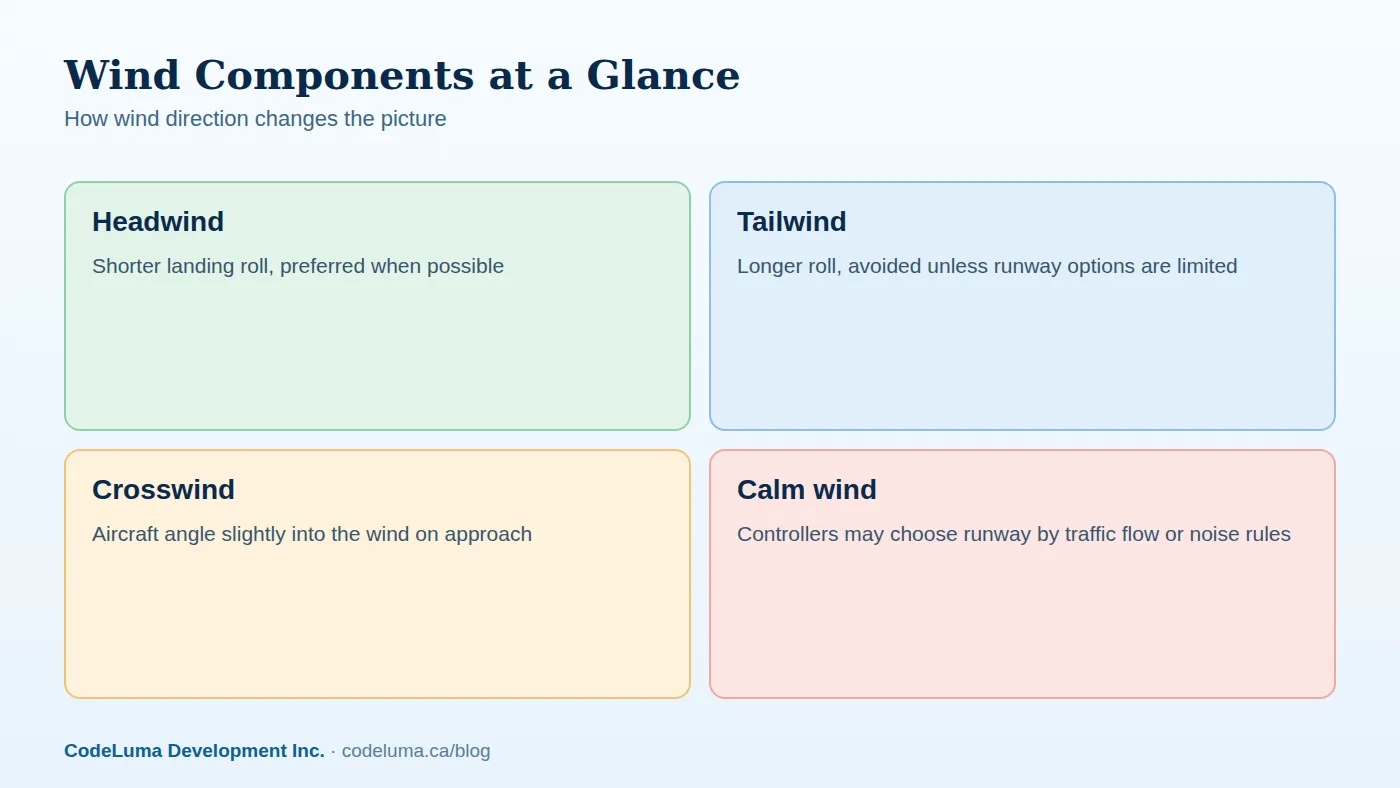
- Headwind: wind blowing toward the nose of the aircraft, shortening takeoff and landing distances.
- Tailwind: wind blowing from behind, which lengthens the distance needed and is generally avoided when a better option exists.
- Crosswind: wind blowing across the runway rather than along it, requiring pilots to angle the aircraft slightly to stay aligned with the centerline.
Most days bring some mix of these, since wind rarely blows perfectly down a runway's exact heading. Airports with crosswind limits will sometimes switch runways, or even close one, if the crosswind component gets too strong for the aircraft using it.
How Pilots and Controllers Decide the Active Runway
At towered airports, air traffic control monitors wind readings and announces the active runway to pilots. At quieter airports, pilots check wind information themselves and choose accordingly. Either way, the decision usually comes down to the runway direction with the strongest headwind component, balanced against other factors like which runway has the right approach aids, how traffic is flowing, and sometimes community noise agreements. A runway change doesn't happen for every small gust; there's generally a wind threshold before anyone bothers switching.
Runway Numbers Are Compass Directions in Disguise
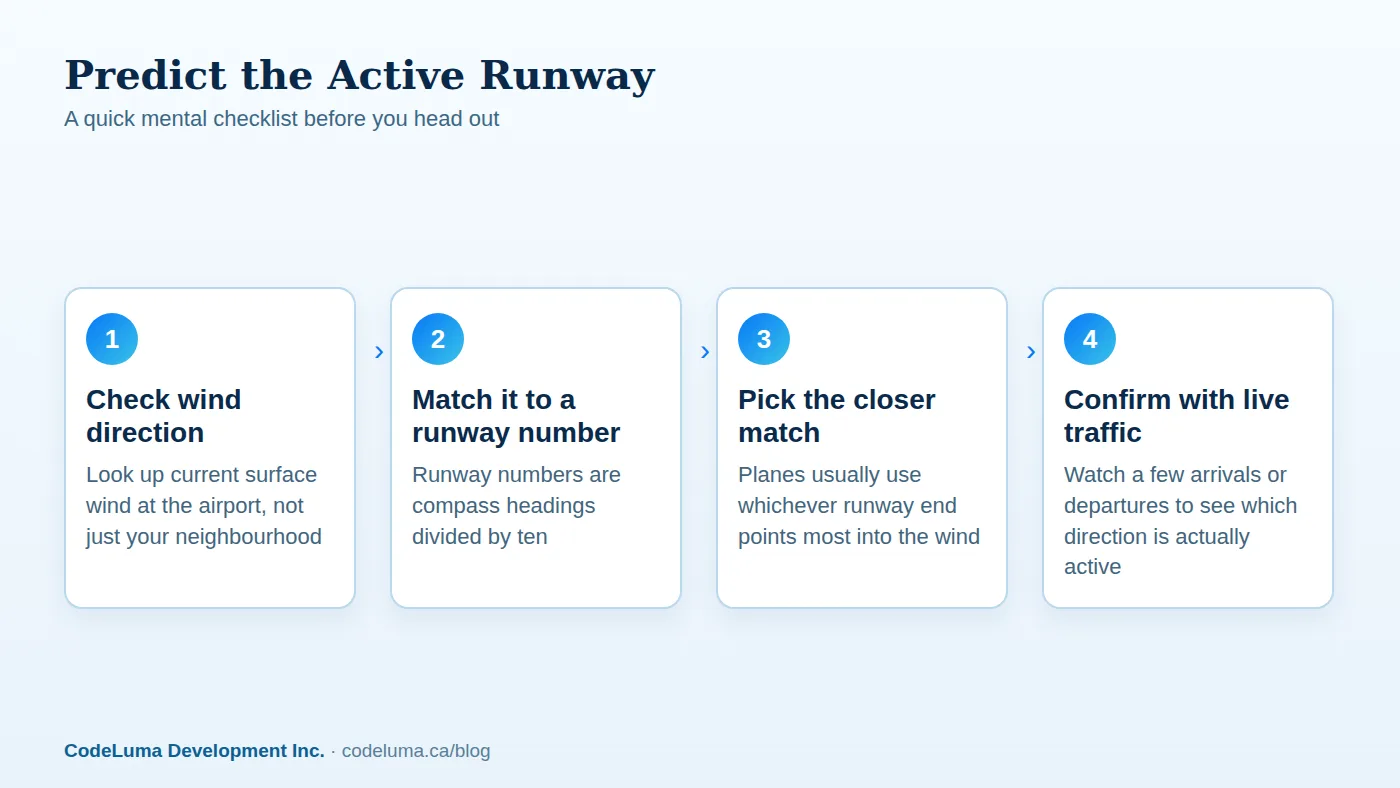
Here's where it gets genuinely useful for prediction: runway numbers correspond to compass headings, rounded to the nearest ten degrees. A runway labeled "27" points roughly 270 degrees, which is due west. Its opposite end would be "09," pointing east. So if the wind is blowing from the west, Runway 27 is the likely candidate, since landing or departing on it means facing into that wind. For a deeper walkthrough of how these numbers work, see our guide to reading runway numbers.
When and Why the Active Runway Changes Mid-Day
Wind doesn't stay constant. A sea breeze can build through the afternoon and reverse the morning's pattern. A passing weather system can swing wind around entirely within an hour. When that happens at a busy airport, you'll sometimes notice a brief lull in arrivals or departures while controllers reorganize the flow for the new runway direction. If you're watching from the same spot for a while, don't be surprised if the traffic pattern you saw at breakfast is completely flipped by lunchtime.
How to Predict Which Way Traffic Will Flow Near You
You don't need to be a meteorologist to make a reasonable guess. Check a general weather source for the current wind direction near the airport, then think about which runway heading that wind favors. Local geography matters too: airports near coastlines, mountains, or large bodies of water often have their own predictable daily wind patterns that locals and regular spotters learn over time. Once you have a guess, the fastest way to confirm it is to watch a handful of real aircraft tracks. SmartMarty Sky's airport directory lists airports worldwide, and watching live movement in Map View or the 200-kilometre radar-style Sky View will show you, within minutes, exactly which direction planes are actually flying.
Watching It Happen Live with SmartMarty Sky
This is one of the most satisfying ways to use live aircraft tracking: make your prediction based on wind, then watch it play out. Open Sky View from a spotting location and see aircraft climbing out or descending in the direction you expected. Over a few sessions, you'll start recognizing an airport's personality, which runways it favors in which winds, and roughly what time of day changes tend to happen. If you want to try this on your next outing, install SmartMarty Sky on your phone or browser; new accounts also get 100% free access to explore the full experience.
Common Mistakes Spotters Make About Wind and Runways
A few habits trip up even enthusiastic spotters:
- Checking wind at your own location instead of at the airport, which can differ meaningfully, especially near coasts or hills.
- Assuming the active runway never changes during a visit, then being confused when traffic suddenly reverses direction.
- Forgetting that calm or light wind days give controllers more flexibility, so the "obvious" runway choice from wind alone may not apply.
- Showing up at a spot that only works for one runway direction, then finding the airport is using the opposite one that day.
A Quick Pre-Spotting Checklist
Before heading out, run through this short list:
- Look up current wind direction and speed at the specific airport, not just your general area.
- Note the runway headings at that airport and match them against the wind.
- Pick a spot that works for your best-guess runway, ideally one with a clear sightline in both directions.
- Confirm with a few minutes of live tracking before settling in for a long session.
- Stay flexible; if the wind shifts, the traffic pattern might shift with it.
Wrap-Up: Wind Is the Airport's Daily Script
Wind direction quietly writes the script for every airport's day, deciding which runway gets used, which neighbourhoods hear departures, and which direction you should be facing with your camera. Understanding this one principle turns a guessing game into an informed prediction, and pairing that prediction with live tracking turns it into a confirmed fact. For more background on the broader system behind what you're watching, browse the SmartMarty Sky blog for related guides on reading the sky like a regular.
See what is flying overhead
Curious which runway is active near you right now? Open SmartMarty Sky's Map View or Sky View to watch arrivals and departures line up in real time, and see for yourself how the wind is steering today's traffic. New accounts get 100% free access to try it out.
- Airport directory - medium and large airports worldwide, browsable by country.
- Create your free account - SmartMarty Sky is 100% free, with no ads and no credit card.
- Install SmartMarty Sky - Android, iPhone and iPad web app, Windows, Linux and browser options.
- Blog - more aviation stories and guides.
Look up and know. SmartMarty Sky shows live nearby aircraft on a radar-style Sky View and a worldwide map. Every feature is 100% free — no ads and no credit card. It is an enthusiast information tool, not a navigation or safety system.