
A dot crosses the sky, and before you can read a tail number or hear an engine note, your brain is already asking: what is that? Identifying an aircraft by silhouette alone is one of the oldest skills in plane spotting, and it is still useful even in an age of live tracking apps. Learning to read wings, tails, engines and fuselage shape turns a fleeting shadow into an educated guess, and gives you something to check once you reach for a screen.
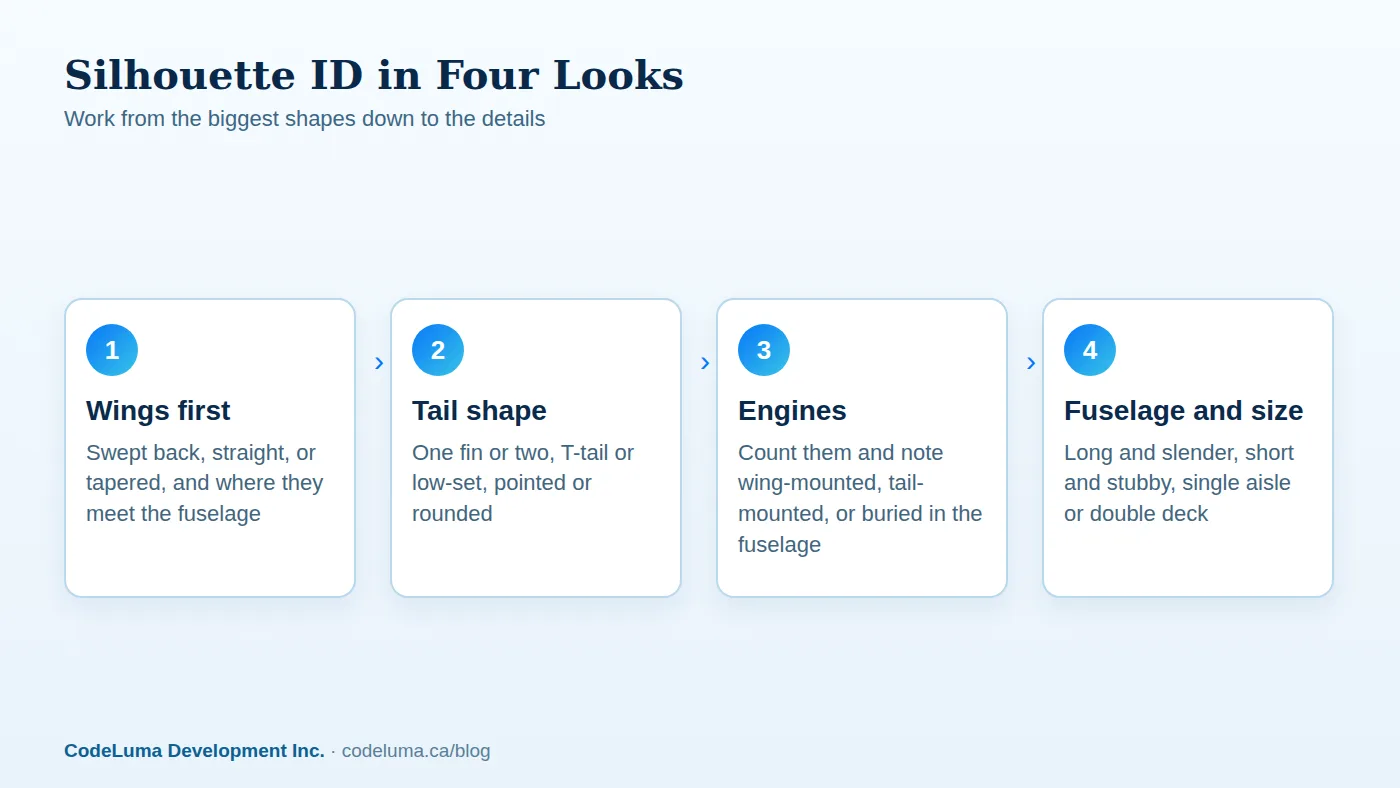
This is a skill built on pattern recognition, not memorization of every type ever built. A handful of visual cues, looked at in the right order, will get you remarkably close most of the time.
Why silhouette reading still matters
Before live tracking was in every pocket, spotters trained their eyes because that was the only tool available. That skill has not become obsolete, it has become a complement. Reading a silhouette quickly tells you roughly what you are looking at, and a tool like SmartMarty Sky then tells you exactly what it is, including its route and registration if that public data is being broadcast. The two work together: your eyes narrow the field, the data closes it out. If you want the fuller story on how that matching happens behind the scenes, see how an ADS-B message is built.

Start with the wings
Wings are usually the first thing your eye catches, and they carry a lot of information. Swept-back wings, angled behind the fuselage, are common on jets built for higher cruising speeds. Straight wings, set at roughly a right angle to the fuselage, usually belong to smaller propeller aircraft or some regional turboprops built for shorter hops at lower speeds. Wing position matters too: high-mounted wings sitting above the fuselage are typical of many military transports and some regional turboprops, while low-mounted wings running through the belly of the fuselage are the standard layout for most airliners.
Check the tail shape
The tail is the next big clue. A single vertical fin is the most common arrangement and tells you relatively little on its own, but its shape and height relative to the fuselage can help narrow things down. Twin vertical fins, spread apart at the back, are a distinctive feature found on some military fighters and a handful of other designs, and they stand out immediately once you know to look for them. A T-tail, where the horizontal stabilizer sits on top of the vertical fin rather than partway down it, is another strong clue, often seen on some regional jets and business jets with rear-mounted engines.
Count and place the engines
Engines are one of the fastest ways to eliminate possibilities. Two engines, mounted under the wings, describes the vast majority of modern airliners you will see at any given airport. Four engines is a rarer sight today and usually points toward a handful of long-haul or specialized cargo types still in service. Engine placement matters as much as count: wing-mounted versus rear-fuselage-mounted versus tail-mounted all produce very different profiles, and a rear-mounted pair tucked close to the tail is a strong hint toward certain regional and business jet families.
Read the fuselage shape and size
The body of the aircraft tells you about its role. A long, slender fuselage usually means a stretched passenger variant built to carry more people over the same basic airframe. A short, stubby fuselage often belongs to a shorter-range or smaller-capacity version of the same family. A double-deck profile, with a visible upper hump running along part or all of the fuselage, narrows things down to a very small handful of aircraft worldwide. Nose shape can help too: a blunt, rounded nose versus a long, tapered one is often enough to separate a cargo freighter conversion from its passenger sibling.
Factor in size and altitude
Distance and height distort everything, so context matters. An aircraft low on approach will show far more detail than one crossing high overhead at cruising altitude, where haze and glare can flatten a shape into a generic sliver. Comparing the aircraft to things you already know, like the length of a runway or the size of a nearby building, can help you judge scale before committing to a guess. Light conditions change fast too, which is part of why choosing a good spotting location with a clear, uncluttered sightline makes silhouette reading so much easier.
Common mistakes to avoid
A few habits trip up even experienced spotters:
- Guessing from engine sound alone, which varies with power setting and distance far more than with aircraft type.
- Assuming livery colours tell you the aircraft type, when in fact the same paint scheme can appear on several different airframes.
- Judging size without a reference point, which makes almost everything at altitude look roughly the same.
- Locking in on a first guess too early instead of running through wings, tail, engines and fuselage in order.

A quick mental checklist
Keep the order simple: wings, tail, engines, fuselage, then size and context. Running through the same sequence every time builds the kind of fast pattern recognition that experienced spotters rely on without consciously thinking about it.
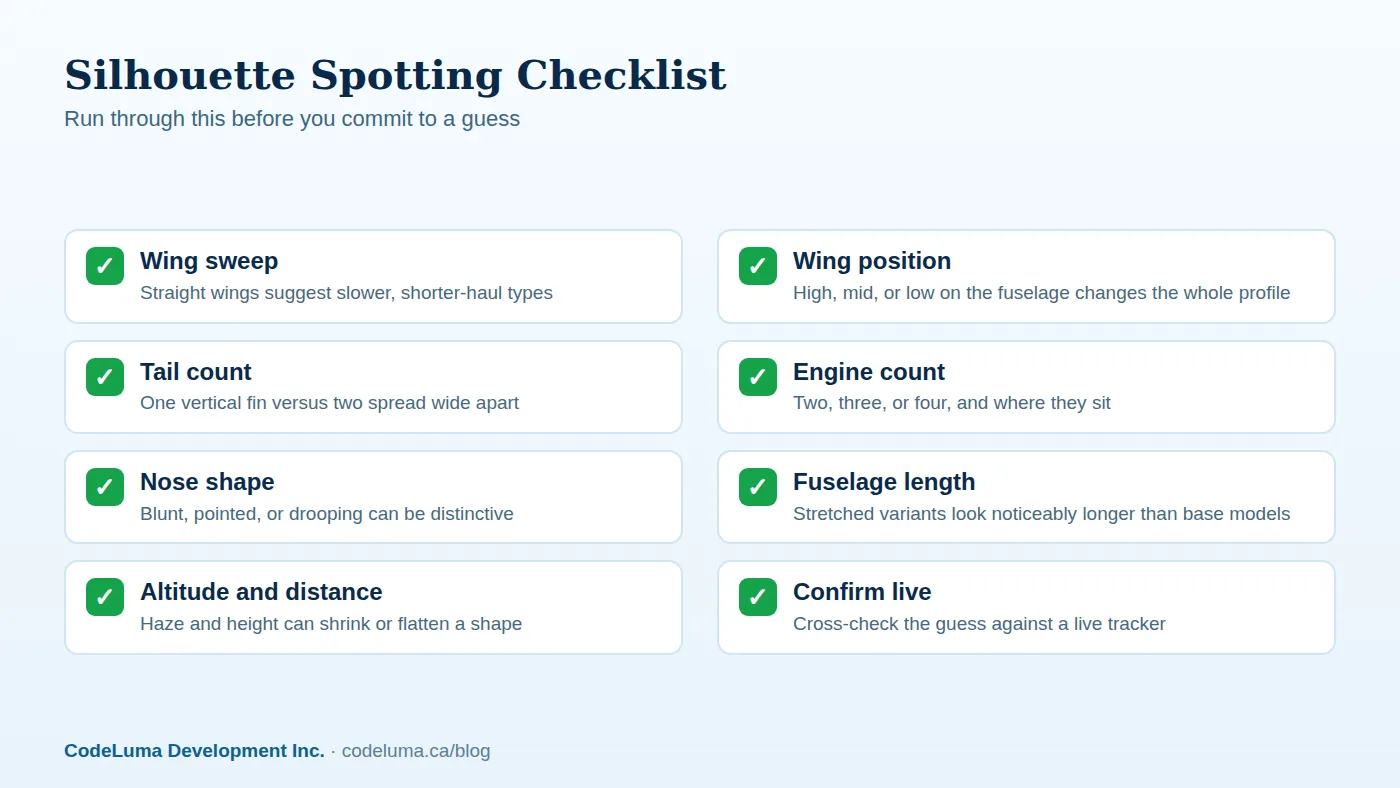
Confirm your guess with a live tracker
Once you have a working theory about what is overhead, the fastest way to check it is against live public broadcast data. Open SmartMarty Sky's radar-style Sky View to see aircraft within 200 kilometres of your location, or switch to the worldwide Map View if you spotted something from a photo or video and want to search by callsign, registration, or ICAO identity afterward. Seeing the confirmed type next to your own silhouette guess is a genuinely satisfying way to sharpen your eye over time, and it turns every walk or drive near an airport into a small test. SmartMarty Sky is 100% free, so you can compare as many guesses as you like.
Build the habit
Silhouette identification is a skill that improves with repetition far more than with study. The more aircraft you look at and then verify, the faster your brain starts matching shapes without conscious effort. If you are new to spotting generally, our beginner's guide to a first day at the airport covers the basics of where to stand and what to bring. Pair that with regular silhouette practice and a live tracker in your pocket, and you will find yourself naming aircraft types well before they are close enough to read anything written on the fuselage.
Wrap-up
Reading an aircraft silhouette is a simple, repeatable process: wings, tail, engines, fuselage, then context. It will not always give you a precise type on the first try, but it narrows the field quickly and makes the moment of confirmation more rewarding. Create your free account or install SmartMarty Sky on your device of choice, and start pairing your eyes with real public tracking data the next time something crosses overhead.
See what is flying overhead
Guessing a silhouette is half the fun, but confirming it is the best part. Open SmartMarty Sky's Sky View to see what's actually overhead, or use your free account to search any aircraft worldwide by callsign or registration.
- Create your free account - SmartMarty Sky is 100% free, with no ads and no credit card.
- Install SmartMarty Sky - Android, iPhone and iPad web app, Windows, Linux and browser options.
- Airport directory - medium and large airports worldwide, browsable by country.
- Blog - more aviation stories and guides.
Look up and know. SmartMarty Sky shows live nearby aircraft on a radar-style Sky View and a worldwide map. Every feature is 100% free — no ads and no credit card. It is an enthusiast information tool, not a navigation or safety system.